
The number that best predicts whether a small business survives isn’t revenue or profit. It comes down to customer retention: how many people come back to buy a second time. The data here comes from an online store, but the lesson reaches to almost any small business that sells to the same people more than once.
There’s one number I check before almost anything else. Not revenue. Not profit. Not ad spend. I check how many customers come back to buy a second time.
It sounds too simple to matter, but it explains more than any other number that I look at. Take the case I want to show you. This brand had its best year ever, then lost almost two thirds of its revenue the very next year.
I spent time with three years of Shopify data from a small, single-product wellness brand. A direct-to-consumer store selling one main product, the kind of business thousands of people are running right now. The owner let me share the numbers as long as the brand stays anonymous, so it will. I worked out every figure here myself from the raw order export instead of trusting a dashboard, because the things worth knowing usually hide in the gap between what a dashboard says and what actually happened.
What I found was an ordinary mistake I see all the time. And because this brand rose and fell so sharply inside three years, it shows very clearly what that mistake costs when nobody catches it.
The number that should worry you
Here is where I would start if this were your store.
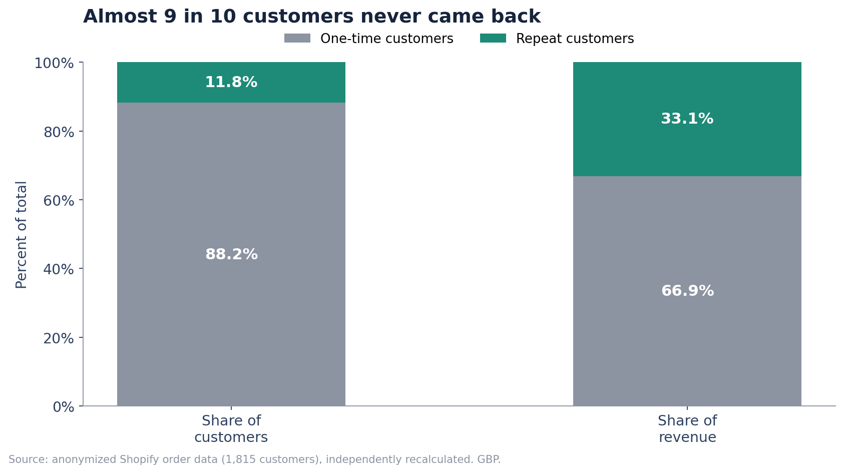
Out of every customer this brand brought in over three years, 88.2% bought once and never came back. Only 11.8% ever placed a second order.
A single low number is easy to brush aside. Maybe this brand was simply bad at keeping customers. So I went looking for what a normal repeat rate actually is, and that turned out to be a more interesting question than I expected.
The figure you see quoted most often is that the average store keeps 25 to 30% of its customers. It gets repeated everywhere, usually with no method attached and usually by someone selling retention software, which is worth keeping in mind. When you look at data that shows its working, the honest answer is that there is no single normal. It depends almost entirely on what you sell.
The cleanest large study I found, a 2026 benchmark report that pooled more than 156,000 customers across consumables, fashion and durables with its method laid out in the open, put the all-brand figure at just 18.8%. Roughly four in five customers bought once and were gone. That is the all-categories baseline, and on its own it sounds like it lets this brand off the hook.
It doesn’t, and here is why. That 18.8% blends together businesses with completely different natural rhythms. Furniture and jewellery sit near the bottom, often under 15%, because nobody buys a sofa every quarter. Consumables sit at the top. When a product gets used up and needs replacing, supplements, coffee, skincare, the same data showed the strongest brands reaching 39, 41, even 44%, and the rule of thumb across the industry is that a healthy consumable brand lands somewhere around 30 to 40%.
This brand sold a wellness product people consume and run out of. It belonged in that top group. It should have been one of the businesses where coming back is easy, because the reason to return is built into the product itself.
It came back at 11.8%.
So this was never a case of an average store posting an average number. It was a brand sitting in the highest-retention category there is, performing closer to a furniture shop. The leak wasn’t normal for what it sold. It was the warning sign, hiding in plain sight, that something about the second purchase was badly broken.
This brand just hadn’t found out what it cost yet.
It was about to.
What the leak actually costs
A low repeat rate isn’t only about missed opportunity. It quietly changes the shape of the whole business.
Look at the money instead of the headcount. Those 11.8% who came back brought in 33.1% of all the revenue. A third of the money from a ninth of the people. Said another way, the average repeat customer was worth £188 over their lifetime, and the average one-time customer was worth £51.
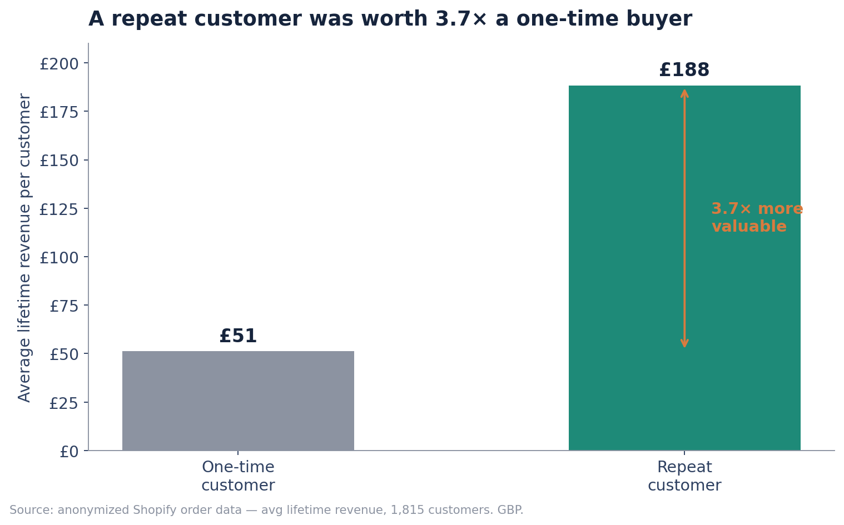
That gap is the whole case for caring about repeat customers. Every buyer this brand won and then lost after one order walked away with about three quarters of their value unspent. The store paid the full price to get them in: the ads, the discounts, the shipping on a first order that barely breaks even for most small brands. Then it collected a third of what that customer was worth and watched them go.
When most of your customers behave like that, you have a business that has to sprint just to stand still. Every month starts back near zero. There’s no growing base of loyal buyers quietly bringing in money while you go and find new people. You aren’t filling a tank. You’re filling a bucket with a hole in it, and the only way to keep the level up is to pour faster.
That works. Right up until you stop pouring.
The year the pouring stopped
This is what makes the brand such a clear lesson. It ran the experiment for us without meaning to.
In 2024 the business had its best year, around £58,600 in revenue, up sharply on the year before. If you only watched the top line, 2024 looked like a brand hitting its stride. Growth. Momentum. The story you tell investors, or yourself.
Then came 2025. Revenue dropped to about £20,700, a fall of roughly 65% in a single year. And it kept sliding into 2026.
I put monthly revenue next to the number of genuinely new customers the brand brought in each month. The two lines move together almost exactly.
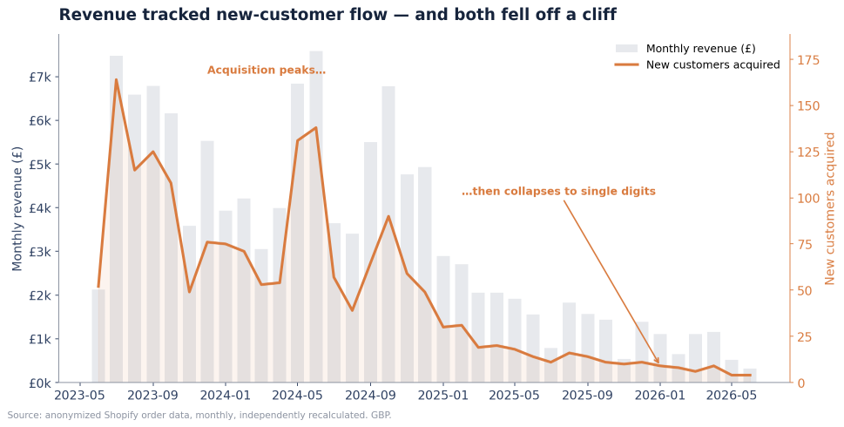
New customers went from 50, 100, sometimes 160 a month at the peak, down to single digits by late 2025. Some months the brand brought in fewer than ten. The collapse wasn’t a mystery. The store had always run on a steady stream of first-time buyers, and when that stream dried up there was almost nothing underneath to hold the revenue up, because the customers from all those earlier months had mostly never come back.
I want to be straight about what this proves and what it doesn’t. It does not tell us why acquisition slowed. Could have been ad costs, a channel that stopped working, more competition, plenty of things, and I can’t say which from this data. What it does show clearly is that the business had no cushion. A brand with a healthy repeat base can ride out a bad stretch of acquisition, because returning customers keep buying while it fixes the top of the funnel. This brand couldn’t, because the repeat base was too thin to catch anything. The leak didn’t cause the fall. The leak is why the fall was a cliff instead of a dip.
And here’s the part I find most telling. While revenue was collapsing, the average order value actually went up, from about £55 to £63. The people still buying were spending more, not less. The problem was never that customers stopped valuing the product, or that the price was wrong. The loyal core was real and it was healthy. There just wasn’t enough of it.
The discount lesson hiding underneath
One more thing worth noticing, because it’s where a lot of owners reach for the wrong fix. This brand discounted enough to matter, about £19,000 over the period, roughly 15.5% of revenue.
That sounds like a problem, but the data was more interesting than that. Customers who bought with a discount were more likely to come back than customers who didn’t. That doesn’t prove the discount caused the return. It might just mean the people who respond to campaigns were more engaged to begin with. But it does kill the lazy answer of “stop discounting.”
The better lesson is simpler. Discounts aren’t the enemy. Discounts you don’t measure are. A discount should have a job. Win the first order. Trigger the second. Move a bundle. Win back a lapsed customer. Track an influencer. If one generic code is doing all of those jobs at once, you have no idea which one worked. Split the codes by purpose, then judge each one by the behaviour it creates. A first-order code shouldn’t be judged on first-order sales. It should be judged on whether those buyers come back.
The window you’re probably missing
If the leak is the problem, the next question is when you can do something about it. So I looked at the customers who did come back and measured how long they took.
Half of everyone who ever made a second purchase did it within 90 days of the first.
That’s the window that matters. The first three months after a first order is when someone is most likely to come back, and for a product you use up, like this one, that’s about when the first jar or bottle runs out.
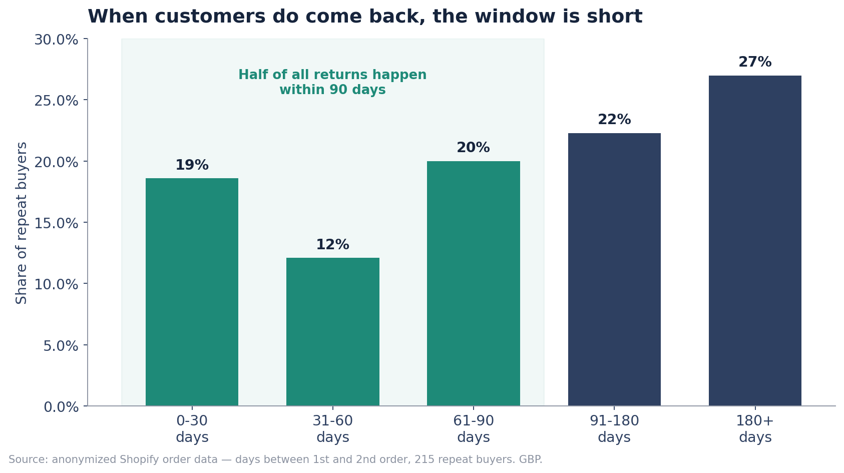
That’s the chance this brand kept missing. Someone who just got a product they’re happy with is, for a short stretch, far more likely to reorder than they will ever be again. If nothing reaches them in that window, no reminder, no nudge, no reason to return, most of them just don’t. The 88% who never came back weren’t all a lost cause. A good number of them were simply never given a reason during the short window when they might have said yes.
What I’d actually do about customer retention
I don’t trust articles that point at a problem and then stop. So here’s the practical version, the same thing I would tell any owner whose store looked like this.
First, find out if you even have the problem. You don’t need software. Export your orders and work out what share of your customers have ordered more than once. What counts as healthy depends on what you sell. A brand selling something people use up should be comfortably past 30%, while big one-off purchases sit far lower. If you’re well under the mark for your kind of product, there’s real money sitting in that gap, and that one number is worth more than most of the dashboards people pay for.
Second, treat the first 90 days after a first order as the most valuable time you have. For something people use up, that means a reminder timed to roughly when it runs out. For anything else, it means giving a happy new customer a clear reason to come back before they forget you. It’s the highest-return work most small stores can do, and it’s cheaper than finding a stranger.
Third, and this is more a change of mind than a tactic. Stop reading a good month as proof the business is healthy. A record month built entirely on new customers you won’t keep is not the same as a record month built on a growing base who come back. They look identical on a revenue chart. Underneath, they are completely different businesses. This brand couldn’t tell the two apart until the difference was the whole story.
Five questions I’d ask before spending more
Before putting more money into ads, influencers, or discounts, I’d want the owner to answer five plain questions from their own data:
- What share of customers bought once and never came back?
- What share placed a second order within 90 days?
- Which product gives the best chance of a second purchase?
- Which discount codes bring customers who return, not just buy once?
- Which campaign brings the best customers, not just the most orders?
If you can’t answer those, you don’t just have a retention problem. You have a visibility problem. You might still grow, but with far less control than you think.
The real lesson
What I keep coming back to is how ordinary this brand’s mistake was. It did nothing reckless. It had a real product people liked, it grew, it had its best year. The leak was there the whole time, hidden under the growth, because growth is very good at hiding leaks. Only when acquisition slowed did the hole become the one thing that mattered.
That’s why I check the repeat rate first now. Not because keeping customers beats everything else, but because it’s the number most likely to be quietly deciding your future while you’re looking somewhere else.
Plenty of online stores are leaking customers faster than they realise, and most never check the one number that would tell them. The difference between the ones that grow and the ones that fall apart usually isn’t the product, and it isn’t even the marketing. It’s whether they spotted the hole in the bucket before they stopped pouring.
(All figures in GBP, taken from the brand’s own Shopify export.)

Sibte H. is the founder of FinThinkers, with over a decade in finance across multiple industries. He helps business owners see their numbers clearly and make confident decisions.